



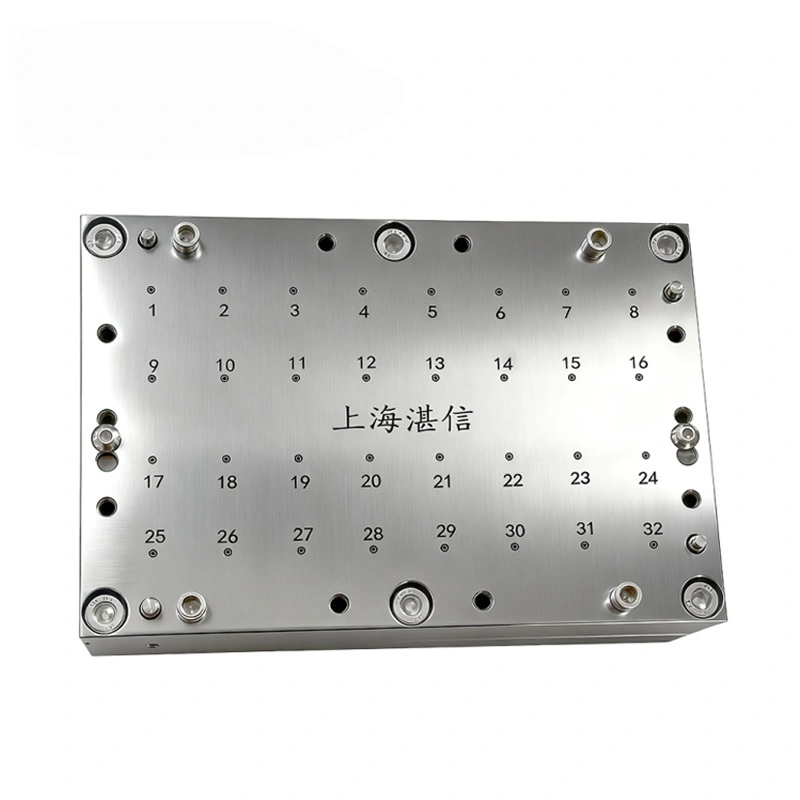
TIPS Polymer Fiber Spinning Melt Spinning Spinneret 32 Holes
Thermally Induced Phase Separation (TIPS) spinneret—also called a TIPS spinning spinnerette—is a core precision component in TIPS membrane and fiber production. It forces a hot polymer–diluent solution (e.g., PP, PE, PVDF, PES blends in high-boiling diluents) through micro‑fabricated orifices and annular channels under elevated temperature and pressure to uniformly extrude continuous filaments or hollow fibers. Outlet features typically span from tens of micrometers to a few millimeters, tailored to target lumen size, wall thickness, and permeability–strength requirements. Immediately downstream, controlled cooling/quenches trigger phase separation and solidification, establishing the membrane’s pore structure.
Like melt extrusion spinnerets, TIPS spinnerets must solve three key challenges, with added emphasis on thermal stability and solution rheology:
- Uniform distribution of the hot dope: multi-zone heating, balanced manifolds, and low-dead-volume flow splitters ensure isothermal conditions and equal flow across all capillaries, preventing premature phase separation and gel defects.
- Precise shaping and control: concentric annular geometries with lumen needles, optimized land lengths, and anti-swirl straighteners stabilize the flow, define OD/ID and wall thickness, and promote reproducible skin formation for targeted asymmetric or graded porosity after extraction.
- Resistance to corrosion and wear: chemically compatible, high-temperature alloys and coatings withstand hot diluents, cleaning agents, and abrasive fillers; high-polish surface finishes minimize die lines and fouling.
Advanced designs may integrate real-time temperature sensing near the exit land, co-extrusion ports for core–sheath or multilayer structures. Properly engineered, a TIPS spinneret delivers stable extrusion, controlled phase separation, and consistent, high-porosity membranes and fibers for water treatment, battery separators, medical devices, and gas/gas–liquid separation.r.
Working Principle

Polymers (e.g., PET, PA, PP) are heated in an extruder to a molten, viscous state.
The melt is precisely metered and fed into the spinneret assembly. Internal distribution channels are designed to deliver the melt uniformly and steadily to each capillary.
Under high pressure, the melt is forced through extremely small capillaries typically 0.28–1.5 mm in diameter. This imposes strong shear, orienting polymer chains to some extent along the flow direction.
Upon exiting the capillary, elastic recovery causes the filament diameter to expand slightly.
Trustech Spinneret Key Design Elements Trustech
These parameters are fundamental to spinneret design and directly determine the membrane's final performance
|
Parameter |
Description |
Influence on membrane performance |
| Flow channel (R) | The runner for transporting, buffering, and distributing the dope and bore fluids. | Different structures should be optimized according to material properties, viscosity, spinneret orifice size, and hole quantities to achieve optimal spinning performance. |
| Annular gap width (d) | The gap (thickness) of the dope flow channel. | It primarily determines the hollow fiber wall thickness. Narrower gaps yield thinner walls and lower mass-transfer resistance, but may reduce mechanical strength. |
| Bore tube outer diameter (d₁) | The outer diameter of the central tube forming the inner wall of the annular gap. | Together with the outer sleeve inner diameter, it defines the annular gap width. |
| Outer sleeve inner diameter (d₂) | The inner diameter of the spinneret outer sleeve forming the outer wall of the annular gap. | Together with the bore tube outer diameter, it defines the annular gap width and the fiber outer diameter. |
| Central tube inner diameter (d₃) | The diameter of the bore fluid channel. | It primarily determines the fiber inner diameter. The inner diameter affects membrane module packing density and the pressure drop of fluid inside the fiber. |
| Length-to-gap ratio (L/d) | The ratio of the flow channel length (L) to the annular gap width (d). | It affects spinning stability. Designing an appropriate L/d according to material properties and process conditions helps stabilize flow and eliminate entry effects, resulting in more uniform extruded fibers membrane. |
| Concentricity | The coaxial alignment among the dope layer inner diameter at the spinneret outlet and the bore tube inner and outer diameters. | It affects wall-thickness uniformity and bubble point pressure. |
| Extrusion face geometry | The foremost geometry of the spinneret, such as flat or micro-tapered. | It influences draw-down and deformation after extrusion, especially important for the air-gap segment in dry-wet spinning. |
The Advantages of Trustech TIPS Spinneret
Product Parameters
|
Brand |
Trustech |
Application |
TIPS/Melting |
| Material | SUS304, SUS630, SUS316L | Holes/Pack | 1-32 holes |
| Dope inlet Thread | G1/8, BSP1/8, NPT1/8 | Minimum membrane OD | 0.20mm |
| Bore liquid inlet thread | G1/8, BSP1/8, NPT1/8 | Customize thread | Yes |
| Precision | ±0.002mm | Concentricity | 0.003mm |
| Design | Conventional design/ FCT design | Connections | Standard |
| Viscosity application | 1000-500000cp | Roughness | Ra 0.4-0.8 |
| Solvent | No | Temperature | 260℃ |
Suitable Materials
PET(Polyethylene Terephthalate), PP (Polypropylene), PA6( Polyamide 6 ), PE (Polyethylene), PLA (Polylactide),TPU (Thermoplastic Polyurethane), PPS (Polyphenylene Sulfide), PTT (Polytrimethylene Terephthalate), PBT (Polybutylene Terephthalate), PVA (Polyvinyl Alcohol ), PAN (Polyacrylonitrile ), PEEK (Polyether Ether Ketone), PVDF-HFP( Poly vinylidene fluoride-co-hexafluoropropylene)
Common Specifications
| No. | General Specification | Application | Design Type | Type |
| 1 | 1.4/0.8/0.6 | TIPS/Melting | Conventional design/ FCT design | Single-aperture/ Multi-aperture |
| 2 | 1.5/0.9/0.6 | TIPS/Melting | Conventional design/ FCT design | Single-aperture/ Multi-aperture |
| 3 | 1.6/1.0/0.6 | TIPS/Melting | Conventional design/ FCT design | Single-aperture/ Multi-aperture |
| 4 | 1.8/1.1/0.5 | TIPS/Melting | Conventional design/ FCT design | Single-aperture/ Multi-aperture |
| 5 | 1.9/1.2/0.6 | TIPS/Melting | Conventional design/ FCT design | Single-aperture/ Multi-aperture |
| 6 | 2.0/1.0/0.7 | TIPS/Melting | Conventional design/ FCT design | Single-aperture/ Multi-aperture |
| 7 | 3.1/1.8/1.5 | TIPS/Melting | Conventional design/ FCT design | Single-aperture/ Multi-aperture |
| 8 | 3.1/1.8/1.5 | TIPS/Melting | Conventional design/ FCT design | Single-aperture/ Multi-aperture |
| 9 | 3.2/2.2/1.8 | TIPS/Melting | Conventional design/ FCT design | Single-aperture/ Multi-aperture |
| 10 | 3.3/1.1/0.9 | TIPS/Melting | Conventional design/ FCT design | Single-aperture/ Multi-aperture |
| 11 | 3.4/2.4/2.0 | TIPS/Melting | Conventional design/ FCT design | Single-aperture/ Multi-aperture |
Customer Membrane Examples
ACHIEVEMENTS
FAQ
About Trustech